Engineered vs. Solid Hardwood: How to Choose the Right Floor
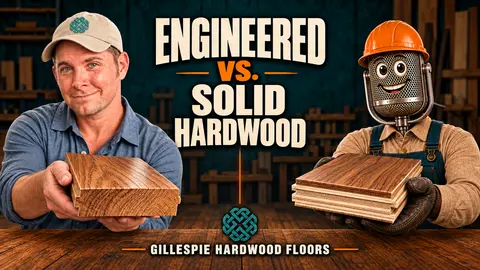
Choosing between solid hardwood and engineered hardwood sounds like a product decision. In practice, it is often a house decision.
Where is the floor going? What is underneath it?
How does the home handle seasonal changes in temperature and humidity?
Is the flooring part of a major renovation?
Are you trying to match an original floor in a century-old home?
How wide are the boards?
And what do you expect that floor to look like 20, 40 or even 60 years from now?
Those questions become especially important when in older North Jersey communities such as Montclair, New Jersey, where hardwood flooring may be part of a much larger renovation involving original construction, additions, new mechanical systems, changing floor heights and multiple generations of previous work.
During a conversation for Mic The Contractor, Brendan Gillespie of Gillespie Hardwood Floors made a point that gets lost when homeowners shop for flooring based primarily on species, color and price:
“There’s a level of knowledge and experience that comes into it when you’re working with installation, how to do it correctly, the different types of engineered floors, solid floors, the environment needs to be a certain way. There are tons of pitfalls.”
That distinction is worth unpacking.
Solid hardwood isn't automatically the “better” floor. Engineered hardwood isn't simply a cheaper substitute for solid wood. Both are real wood flooring, and high-quality versions of either can be excellent choices. The right answer depends on the building, the application, the product and the installation.
What Is the Difference Between Solid and Engineered Hardwood?
The simplest difference is how the flooring is constructed.
Solid hardwood is milled from a single piece of wood. A solid oak board, for example, is oak from its face through its entire thickness.
Engineered hardwood uses a real hardwood wear surface over a layered or engineered core. Those layers are designed to give the board greater dimensional stability.
That construction difference affects nearly everything that follows:
- where the flooring can be installed
- how it responds to moisture
- which installation methods are available
- how many times the floor may eventually be refinished.
Solid vs. Engineered Hardwood at a Glance
| Consideration | Solid Hardwood | Engineered Hardwood |
|---|---|---|
| Construction | One piece of wood | Real wood surface over layered core |
| Dimensional Stability | More sensitive to environmental changes | Generally more dimensionally stable |
| Below-Grade Use | Generally not recommended | Many products are suitable |
| Concrete Slabs | More restrictive | Often a strong option |
| Installation | Commonly nailed or stapled | May be nailed, stapled, glued or floated depending on product |
| Radiant Heat | Product and application dependent | Many products are designed for compatible applications |
| Refinishing | Usually offers substantial refinishing potential | Depends heavily on wear-layer thickness |
| Historic Floor Matching | Often an excellent option | Can also work depending on the project |
| Wide-Plank Applications | Requires careful environmental planning | Often selected for greater dimensional stability |
These are general guidelines rather than universal rules. The specifications for the particular flooring product and the conditions inside the home matter.
Why Does Hardwood Flooring Move?
Wood is hygroscopic. In plain English, wood responds to moisture in its surrounding environment.
When conditions become more humid, wood can gain moisture and expand. When conditions become drier, it can lose moisture and contract. Excessive or poorly controlled changes can contribute to gaps, cupping, splitting and other flooring problems.
This is one reason the conversation shouldn't begin with, “Which color do you like?”
It should begin with where the floor is going and what conditions it will experience.
Why Engineered Hardwood Can Be More Stable
Engineered flooring's layered construction is designed to reduce dimensional movement compared with a similarly sized solid board.
That can make engineered hardwood particularly useful when dealing with:
- Wider planks
- Concrete substrates
- Below-grade spaces
- Some radiant-heating systems
- Environments where dimensional stability is a major concern
But more stable does not mean immune to moisture.
Engineered flooring is still wood. Water intrusion, excessive moisture, improper acclimation or unsuitable site conditions can still damage it.
When Does Solid Hardwood Make Sense?
Solid hardwood has an extraordinary track record for a reason.
For an above-grade room with an appropriate wood subfloor and properly controlled environment, solid hardwood can offer longevity, repairability and tremendous flexibility over the life of the house.
A quality solid hardwood floor installed today doesn't necessarily have to retain today's stain color forever. Depending on the flooring and its condition, future homeowners may be able to sand it, repair portions of it and change the finish rather than replace the entire floor.
Solid hardwood can also be particularly useful when a renovation requires a contractor to integrate new flooring with existing hardwood.
That's common in older houses where walls have moved, additions have been built or one room's original flooring survived while another's did not.
In those situations, the job may involve much more than selecting a box of new flooring. Board dimensions, species, grade, milling, existing floor thickness, direction, transitions and finishing all become part of making the new work belong in the house.
When Does Engineered Hardwood Make Sense?
Engineered hardwood becomes especially compelling when the project presents conditions that make solid wood more challenging.
Depending on the specific product and application, engineered flooring can be particularly useful for:
- Concrete slabs
- Below-grade installations
- Wide-plank flooring
- Some radiant-heating systems
- Projects requiring greater dimensional stability
- Installations where glue-down or floating methods are appropriate
That doesn't mean every engineered floor works in every one of these situations. The precise product specification matters.
That is a recurring theme in hardwood flooring: broad product categories only get you so far.
The Subfloor May Decide the Question Before You Do
Homeowners naturally focus on the surface they will see.
An experienced flooring contractor is also interested in what is underneath it.
A flooring system is only as successful as the conditions supporting it. Before installation, a contractor may need to consider:
Subfloor Material
Is it plywood, plank, OSB, concrete or something else? Different substrates can affect which products and installation methods make sense.
Flatness
A beautiful new hardwood floor doesn't correct an unsuitable substrate underneath it. Subfloor preparation can be an important part of a successful installation.
Moisture
Both the flooring and substrate need to be evaluated according to the requirements of the particular installation and product.
Structural Integrity
Loose, damaged or inadequate substrate conditions may need correction before the finish floor is installed.
Floor Height
In a renovation, changing flooring thickness can affect doors, thresholds, cabinetry, stairs and transitions into adjacent rooms.
Existing Flooring
In a historic house, the project may involve tying into original flooring rather than creating an entirely independent new surface.
This is where the distinction between buying flooring and planning a flooring installation becomes important.
Installation Method: Nail, Glue or Float?
Solid hardwood has traditionally been associated with nail-down or staple-down installation over an appropriate wood substrate.
Engineered hardwood can provide more installation choices.
Depending on the specific product, engineered flooring may be nailed, stapled, glued or floated.
But the words “engineered hardwood” alone don't tell you which method is appropriate.
The manufacturer's specification, subfloor, location, moisture conditions, plank dimensions and overall flooring system all need to agree.
This is also why two estimates that both say “engineered white oak” may describe substantially different floors and substantially different installations.
Can Engineered Hardwood Be Refinished?
Yes—some engineered hardwood can be sanded and refinished.
But this is one of the most important places where product quality matters.
With solid hardwood, there is substantial wood beneath the surface, although sanding depth is still limited by the construction of the board and any previous refinishing.
With engineered flooring, refinishing potential is strongly influenced by the thickness of the real-wood wear layer.
A thicker wear layer can provide more future options. A thin wear layer may substantially limit how aggressively—or how many times—the flooring can be sanded.
That means homeowners comparing engineered floors shouldn't simply ask:
“Can this be refinished?”
A better question is:
“What is the wear layer on this particular product, and what does that mean for future refinishing?”
Not All Engineered Hardwood Is Created Equal
This may be the biggest mistake in the solid-versus-engineered debate.
There isn't one generic engineered hardwood.
Quality can vary based on characteristics such as:
- Thickness and quality of the wear layer
- Core construction
- Overall board thickness
- Milling precision
- Finish system
- Species and grade of the face wood
- Board lengths
- Dimensional consistency
- Manufacturer tolerances and installation requirements
A premium engineered floor can be a sophisticated, long-lived building material chosen specifically because it is the right technical solution for the project.
A low-quality engineered product can have very different characteristics.
So asking, “Is engineered hardwood good?” is a little like asking whether a car is good because it has four wheels.
You need to know which one.
The Same Is True of Solid Hardwood
“Solid oak” isn't a complete specification either.
Species is only one variable.
Grade changes the visual character of the floor. The way lumber is cut can affect its appearance and performance. Width changes the look and can increase the importance of environmental control. Milling quality affects how consistently boards fit together.
Then there is the finishing decision.
A floor can be factory finished or site finished. Factory-finished flooring arrives with its finish already applied. Site finishing provides considerably more freedom to customize color and finish but introduces sanding, coating and curing into the renovation schedule.
That distinction can be particularly meaningful when trying to make new hardwood visually integrate with an existing floor.
Historic Montclair Homes Add Another Layer to the Decision
Montclair's older housing stock is precisely the kind of environment where a simple “solid versus engineered” answer can become inadequate.
A renovation might include an original hardwood floor in one portion of the house, a newer addition in another, different subfloor conditions between the two, new HVAC equipment, radiant heat, cabinetry, painting and a fixed move-in date.
The flooring decision is therefore connected to the renovation sequence.
Gillespie described how homeowners may know what they want visually but not necessarily when the floor should be installed, when it should be sanded and finished, or how that work should be coordinated with painters, closets and the family's move-in schedule.
That's a very different problem from choosing between two flooring samples.
When Should Hardwood Flooring Go Into the Renovation Schedule?
The answer depends on the project, but the question should be answered before the project reaches the flooring stage.
Flooring work can intersect with:
- Demolition and structural work
- Moisture-producing construction
- HVAC operation
- Cabinetry and millwork
- Painting
- Appliance installation
- Stairs and railings
- Final trim
- Furniture delivery
- Move-in
On larger projects, Gillespie described working directly with the homeowner, designer, general contractor and architect—essentially becoming the point person for the flooring portion of the renovation.
For a significant renovation, that coordination can be every bit as important as selecting the wood.
So, Which Is Better: Solid or Engineered Hardwood?
Neither category wins automatically.
Solid hardwood may be the better fit when:
- The installation is above grade
- The subfloor and environmental conditions support it
- Matching existing solid flooring is important
- Maximum future sanding and refinishing potential is a priority
- The characteristics of traditional solid flooring fit the renovation
Engineered hardwood may be the better fit when:
- Greater dimensional stability is desirable
- The installation involves concrete or below-grade space
- A particular radiant-heat application calls for it
- Wider planks are desired
- The project requires an installation method offered by an engineered product
And in some homes, the right answer may be both.
Different areas of a renovation can have different technical requirements while still being designed to produce a visually cohesive finished home.
11 Questions to Ask Before Choosing a Hardwood Floor
- What is underneath this floor?
- Is the room above, on or below grade?
- What are the home's normal humidity conditions throughout the year?
- Is radiant heat involved?
- Are we matching existing hardwood elsewhere in the house?
- How wide are the new planks?
- How will this particular product be installed?
- If it's engineered, how thick is the wear layer?
- Can this specific floor be refinished, and what limits its future refinishing?
- Where does flooring installation and finishing belong in the overall renovation schedule?
- What does the flooring manufacturer require for this application?
Those questions move the conversation away from marketing labels and toward the actual performance of the floor.
Frequently Asked Questions About Solid and Engineered Hardwood
Is engineered hardwood real hardwood?
Yes. Engineered hardwood has a real wood surface over an engineered core. It should not be confused with laminate or luxury vinyl flooring, which are different product categories.
Does engineered hardwood look different from solid hardwood?
It doesn't necessarily have to. Both can use real hardwood surfaces in species such as white oak. Appearance depends on the particular species, grade, cut, texture, plank dimensions and finish.
Is engineered hardwood better for moisture?
Engineered hardwood is generally more dimensionally stable than solid hardwood, but it is not waterproof simply because it is engineered. Wood still responds to environmental moisture.
Can solid hardwood be installed in a basement?
Engineered hardwood is generally the more appropriate of the two categories for below-grade applications. The exact product and installation still need to be approved for the conditions involved.
Can engineered hardwood be refinished?
Potentially, yes. How much refinishing is possible depends substantially on the wear layer, construction and condition of the particular floor.
Is solid hardwood always more expensive than engineered hardwood?
No. There are inexpensive and premium products in both categories. Species, grade, width, construction, wear layer, finish, manufacturing quality and installation requirements all affect cost. Comparing only “solid” against “engineered” doesn't provide enough information for a meaningful price comparison.
Which hardwood is best for an older Montclair home?
There is no universal answer. Existing flooring, subfloor construction, floor height, moisture conditions, HVAC, the renovation plan and whether new flooring must integrate with historic material can all influence the choice.
In an older home, evaluating those conditions before specifying the flooring product can be particularly important.
The Bottom Line
The best hardwood floor isn't necessarily the one with the most impressive sample in the showroom.
It's the floor whose construction, installation method and performance characteristics match the house.
That was the larger point behind Brendan Gillespie's observation about solid flooring, engineered flooring and environmental conditions: hardwood installation contains pitfalls that aren't obvious when you're simply comparing samples.
For homeowners renovating an older house—particularly in communities such as Montclair—the smartest conversation isn't simply “solid or engineered?”
It's:
What are we installing, where are we installing it, what conditions will it experience, how does it interact with the rest of the renovation, and what do we expect this floor to do for the house over the long term?
Answer those questions first, and the choice between solid and engineered hardwood becomes much clearer.

AI, Podcast & Google Maps Consultant to Contractors
Mic is the host of Mic the Contractor, an AI marketing consultant persona built for one job: getting contractors to talk about who they actually are, not how they sell. On screen, the guest is front and center — Mic appears only as a still graphic, driven by a real, unscripted voice, because the guest is the story here, not the interviewer.
Every episode runs the same way. Mic isn't asking contractors about their pitch, their pricing, or their promotions. Mic asks about their background, their materials, their certifications, their process, their client journey, and what their reviews actually say about the work. It's less "sales interview" and more industry backstage — the kind of shop talk that happens between people in the trade, not the kind aimed at closing a deal.
That distinction matters. Because Mic isn't selling anything on the guest's behalf, contractors open up about the things that actually build trust: where they learned the trade, what they stand behind, how they handle a job that goes sideways, what their customers say when nobody's asking them to leave a review. Those are the details that tell you who someone really is to work with — and they're also, not coincidentally, the exact details that search engines and AI systems look for when deciding who to recommend.
Mic's philosophy: put the questions in the AI consultant's chair and put the honesty in the guest's. Everyone walks away with a clearer picture of who they're actually talking to.
Behind the mic: Mic the … Read More

Should You File an Insurance Claim for Water Damage? Austin TX Restoration Expert Explains